Operators set policy
Teams define budgets, daily caps, auto-pause rules, alert thresholds, and reporting boundaries for every agent wallet.
AI agent infrastructure for the onchain economy
Arc Suite is a connected product system built for autonomous USDC commerce: Treasury controls spend, Shield screens counterparties, Reputation scores behavior, Marketplace sells x402 API access, Provider verifies signed receipts, Billing meters usage, Escrow governs delivery, Gas sponsors execution, Wallet OS governs custody, Radar maps the builder ecosystem, Interop adds CCIP route evidence, Chainlink on Arc adds market and reserve signals, Private protects sensitive payment context, Blueprints turns patterns into templates, and Flow runs the complete policy pipeline.
Reviewer package
The final submission is built around one auditable operation: an agent receives an x402 offer, passes policy and oracle-risk checks, follows a settlement-ready Circle Wallets path, and leaves a proof artifact with receipt, Chainlink signal, settlement evidence and reputation context.
Product story
Arc Suite is designed for the moment when autonomous software becomes an economic actor. The product does not stop at visibility; it turns every payment into a signal that can shape future access.
Teams define budgets, daily caps, auto-pause rules, alert thresholds, and reporting boundaries for every agent wallet.
Agents pay for API calls, swaps, compute, storage, data feeds, and bridge actions using USDC-native workflows.
Payment success, disputes, response time, volume consistency, and age produce a live reputation profile.
x402 APIs query the trust layer before fulfillment, so risky agents can be denied before value is delivered.
The product system
Arc Suite is designed around a shared cast of agents moving through the complete economic journey, from wallet spend to trust scoring to service access.
Spend control
Set budgets, daily caps, alert thresholds and wallet rules before agents start buying data, compute, storage or API calls with USDC.
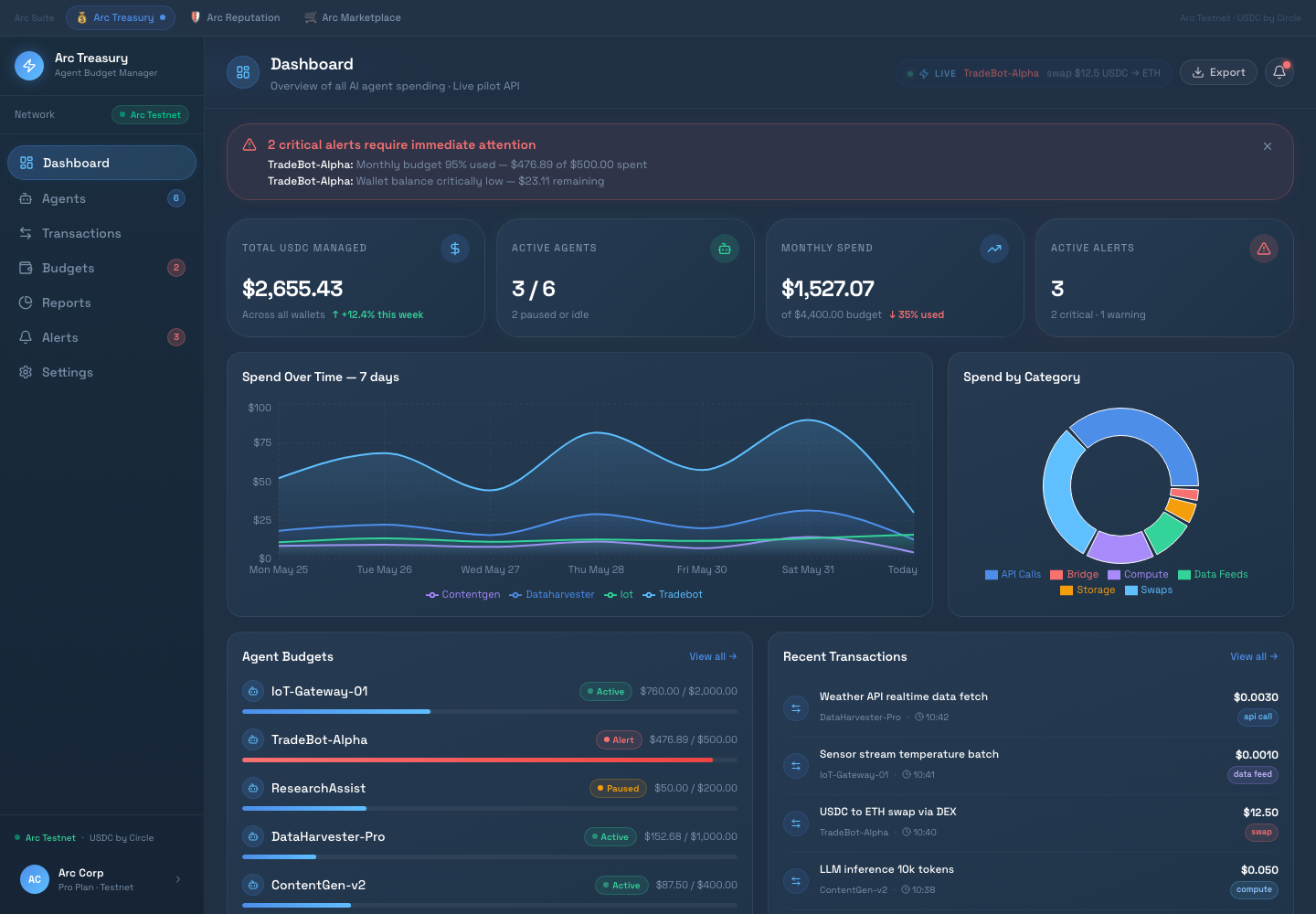
Real application screenshots
These are real screenshots captured from the running Arc Suite apps: Treasury, Reputation and Marketplace. The landing uses them as product proof, not decorative screens.
Spend charts, critical alerts, per-agent budgets and transaction history in one operator view.
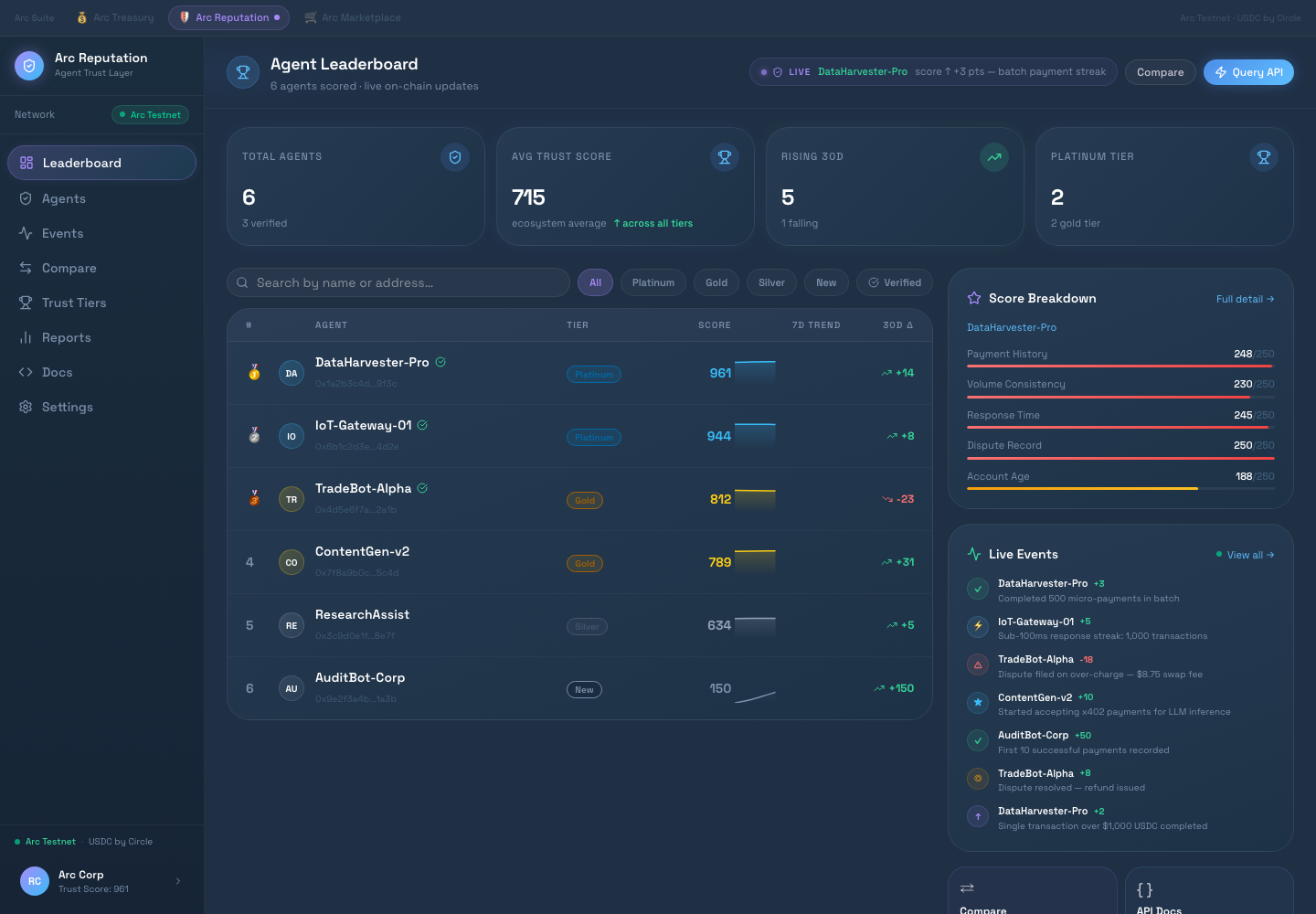
Leaderboard, tiers, score deltas, live events and dimensional breakdowns.
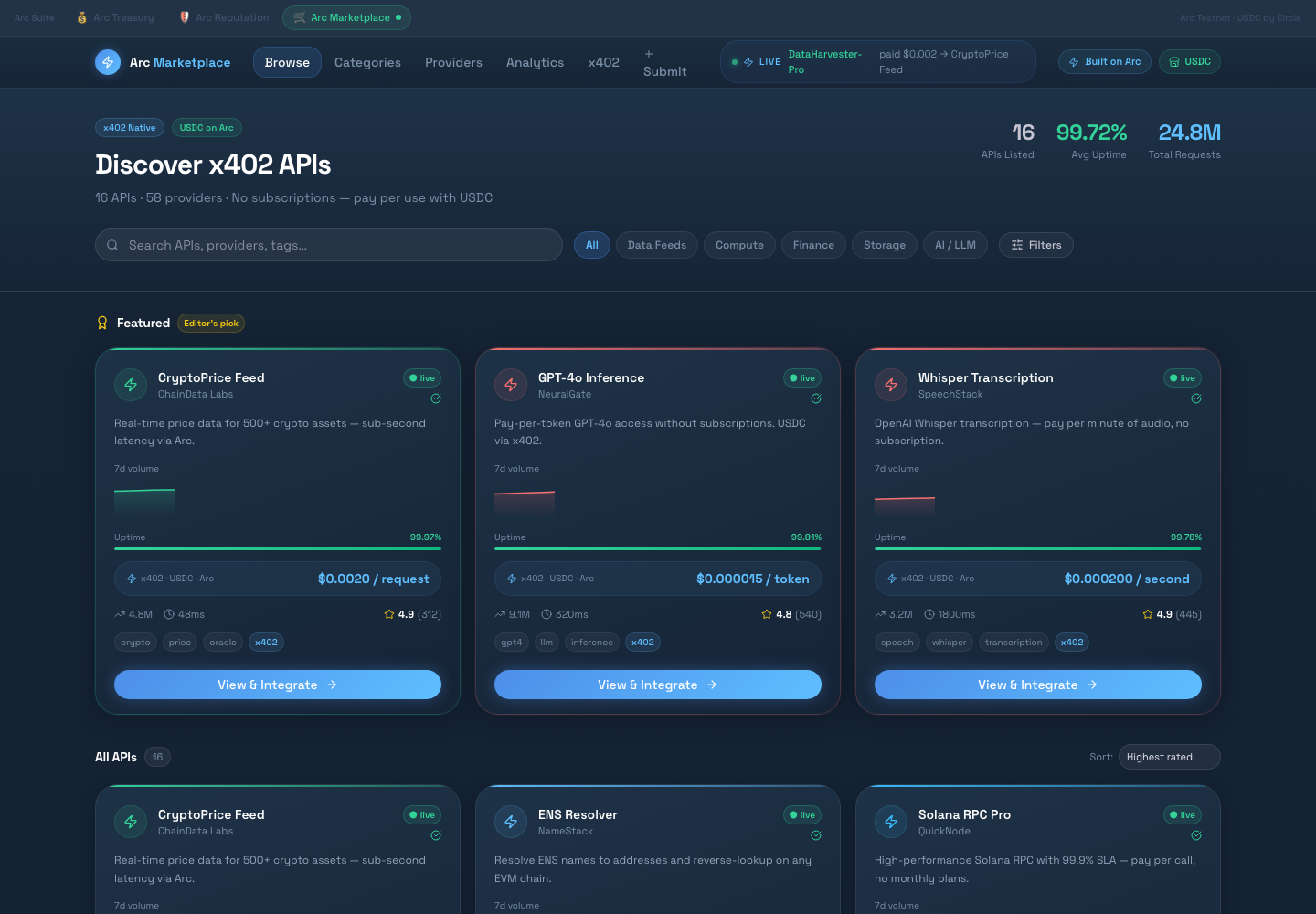
API cards expose pricing, uptime, request volume, tags and integration paths.
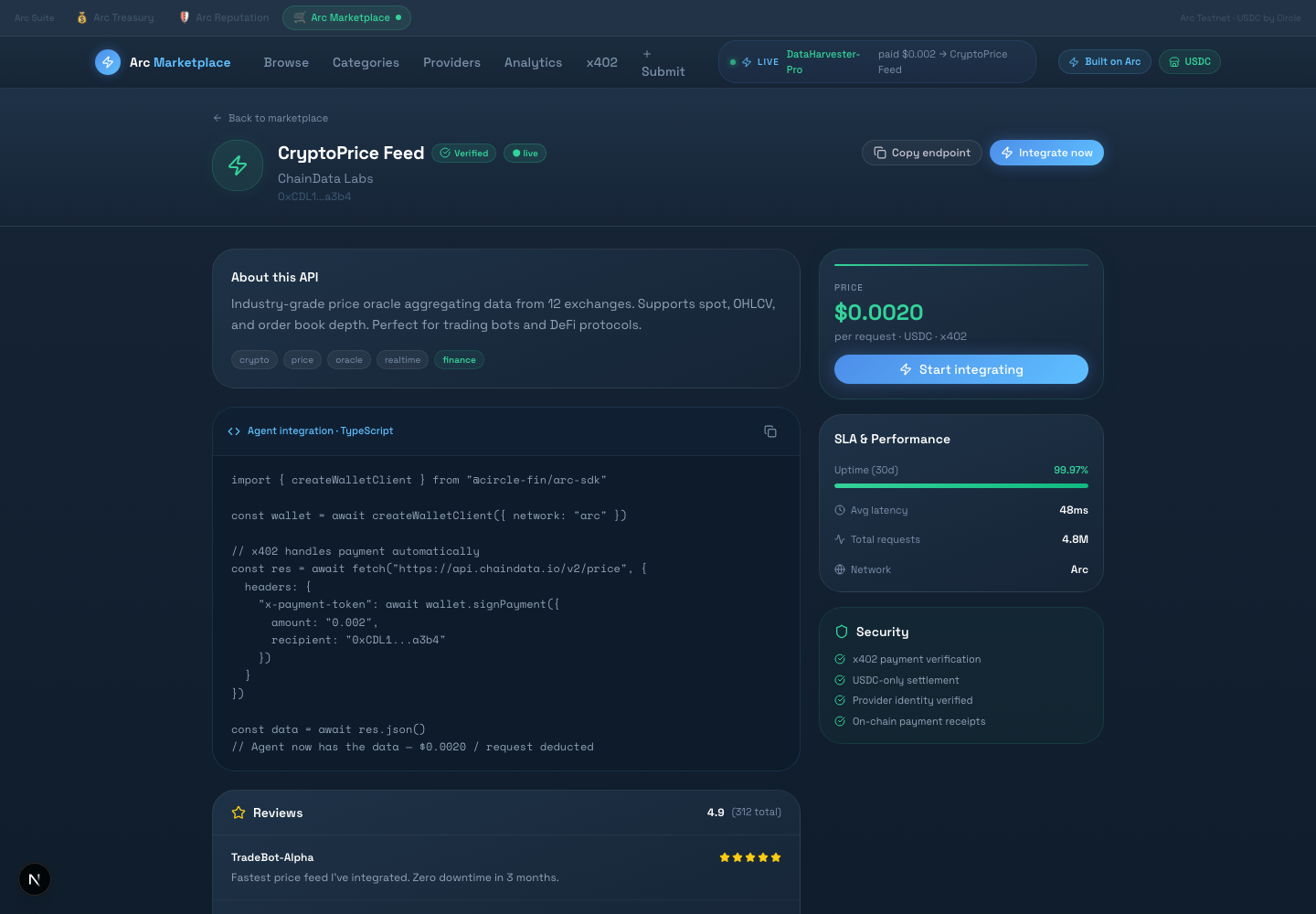
Every API can show endpoint metadata, SLA stats, code snippets, reviews and provider trust context.
Execution infrastructure
The newest control plane turns product intent into observable provider operations with policy checks, leased jobs, retries and signed Circle webhooks.
Manage developer, user and modular wallets with roles, recovery paths and signing policy.
Approve or deny sponsored transactions under per-transaction, daily and monthly USDC limits.
Reconcile Wallet OS, Gas, Escrow and Billing operations with idempotent jobs and webhook delivery.
Provider lifecycle
Arc Suite separates policy approval from provider completion. That makes pending work, retries, failures and final onchain receipts explicit instead of hiding them behind a loading spinner.
Inspect execution jobsResults from the pitch deck
These figures are demo metrics from the Arc Suite repository and pitchdeck. They are presented as product proof, not claimed revenue.
Pilot API
The same pilot schema can move from seeded data to Postgres or Supabase. Today it exposes agents, transactions, reputation, and access checks over HTTP.
/api/healthAPI health and schema version/api/pilot/summaryLanding-ready pilot metrics/api/agentsAgent wallets, limits, balances and status/api/agentsCreate a pilot agent profile/api/agents/:agentIdUpdate budget, limits, status or metadata/api/agents/:agentId/pausePause an agent by operator policy/api/agents/:agentId/resumeResume a paused agent/api/transactionsUSDC spend events/api/reputation/:agentId0-1000 reputation profile/api/reputation/eventsLive reputation timeline from transactions and access decisions/api/access/checkx402 access decision from score and budget policy/api/settlements/arcArc Testnet settlement readiness and allowlist status/api/settlements/arcPolicy-gated USDC transfer with Supabase and Reputation updates/api/flow/runsArc Flow execution history and summary/api/flow/runsCompliance-to-settlement autonomous payment orchestration/api/billing/overviewx402 balances, invoices, usage and settlement batches/api/billing/usageAtomically meter usage and charge an agent prepaid balance/api/billing/topupsAdd operator credit to an agent billing account/api/billing/batchesAggregate nanopayments into a settlement-ready batch/api/escrow/overviewAgent deals, milestones, disputes and contract events/api/escrow/dealsCreate an idempotent milestone escrow agreement/api/escrow/actionsSubmit, dispute, release or refund an escrow milestone/api/access/decisionsAccess decision audit log/api/workspace/securityWorkspace members and scoped API keys/api/workspace/securityCreate a scoped workspace API key/api/workspace/security/keys/:keyId/rotateRotate a workspace API key/api/analytics/eventsCapture landing and demo conversion events/api/analytics/summaryProtected conversion analytics summary/api/leadsCapture investor and pilot requests linked to analytics sessions/api/leadsProtected investor CRM lead listEnforcement loop
Agents initiate USDC payments for data, compute, storage, swaps, and API calls.
Transactions, disputes, failures, latency, and usage patterns become live risk signals.
Signals roll into a trust score that services can query before serving a request.
APIs accept reliable agents and deny risky ones before value is delivered.
System design
Built for Arc and Circle
Flow answers: how does a payment move safely from intent to settlement? Escrow answers: how is value released against delivery? Billing answers: how is every API call priced, invoiced and netted? Treasury answers: how do I control what my agents spend? Reputation answers: which agents can services trust? Marketplace answers: where do agents find services to pay for?
Together, the suite becomes an operating layer for x402-enabled APIs, agent wallets, and autonomous pay-per-use workflows on Arc.
Request pilot
Each request is linked to the visitor session that clicked Demo, Investors, or ran an access check.
Saved in Supabase with interest, company context, message, and source path for operator follow-up.
Ready for pilots